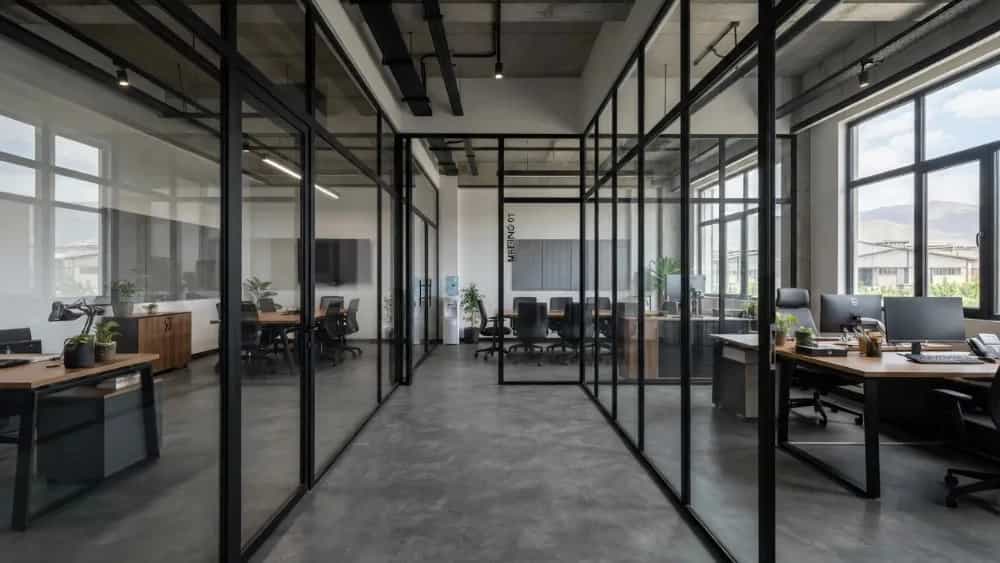
The price of office glass partition in Karaj in 1405 is calculated based on each square meter, the type of glass (thickness 8 to 10 mils or acoustic laminate), aluminum frame alloy and the location of the hall. For normal corporate environments and open offices, a single-wall partition with a thickness of 10 mm is a more economical choice, while for factories located in the industrial hubs of Alborz suburbs, the double-wall sound insulation system is the only solution to control the noise pollution of the assembly lines. In addition to the size of the glass, the final cost includes stainless steel fittings, rail or hinged doors, shutters, and the transportation of executive teams to towns around the city.
According to our operational experience in equipping factory management offices, the biggest mistake of purchasing managers when separating space is to look only at the raw price of tempered glass. Glass without engineering framing and air sealing of seams has no control function on low frequency sound waves of heavy machinery.
The formula for calculating the cost of each square meter of glass partition in Karaj
Financial estimation of glass partitions is based on the gross area of the opening (length multiplied by height), but several coefficients change the output number. A detailed technical pre-factor consists of 5 basic components: the amount of glass used in terms of cut-to-size, the weight of the aluminum profile in kilograms, the package of door accessories (handles, hinges, stops, or facing rails), silicone sealant tapes, and the specialized fee for on-site installation.
In the projects of Alborz province, the height of the factory roofs is significantly different from the office buildings in the city center. When the height of the opening exceeds 3 meters, the glass enters the special cup size, which not only increases the purchase price of the primary material by 35%, but also requires structural restraining devices such as iron can handles hidden in the false ceiling.
Fluctuations in the price of aluminum ingots and billets 6063 in the commodity exchange directly move the rates of specific profiles. Therefore, the stable price offer is only valid based on the final weight of the consumption profile and the shop drawing map.
Technical comparison of single-walled and double-walled glass partitions in industrial applications
The intelligent separation of management, engineering and quality control offices next to noisy production halls requires accurate knowledge of the sound reduction index (Rw) in different partition types.
Frameless single-wall glass partition
This model uses clear, super clear or smoked 10 mil tempered glass along with very delicate aluminum U-shaped profiles on the floor and ceiling. A frameless single-wall partition creates a maximum of 28 to 32 dB of sound loss. This option is only suitable for the separation of internal office sections, the separation of sales rooms and indoor style meetings; Areas where there is no exchange of speakers and press and lathe machines. The installation speed of this system is very high, and its cost per square meter is about 40% less than the double-glazed system.
Soundproof double-walled glass partition
In this structure, two layers of tempered glass (usually a combination of 6 mil and 8 mil with different air gaps to break the frequencies) are placed inside the wide section profiles of anodized or electrostatic powder paint. This system has the ability to install a magnetic shutter curtain between the windows, and its noise reduction reaches 42 to 48 dB. For quality control (QC) offices, factory monitoring rooms, and factory management offices that are attached to warehouse and production line areas, only this configuration meets the standard standards of hearing health for personnel.
The challenges of implementing partition in prominent industrial towns of Alborz province
Installing a glass partition in Alborz climate and workshop context is not similar to installing a shop window. Each of the industrial areas of this province imposes specific logistical and technical challenges on the project manager.
In the industrial town of Simindasht and Baharestan, due to the high density of pharmaceutical and food industries, health standards prevent the use of profiles with deep depressions and dust-catching edges. In these parts, we use flush sections and laminated anti-dust glass with antistatic filter so that clean room approvals are not challenged.
In the industrial towns of Hashtgerd, Nazarabad and Eshtehard, the long transportation distance from the cement factories, the slope of the roads, and the continuous vibration caused by the traffic of the trolleys in the entrance roads, increase the risk of glass breakage or glass breakage in transit. In addition, the temperature difference between day and night is very severe in the sheds of Eshthard area. This issue causes the strong expansion and contraction of the metal structures of the hall, and if the glass winder inside the frames is not observed according to the standard of 5 to 8 mm, in less than one season, the glass will be crushed under tension.
A step-by-step guide to price inquiry and secure purchasing for procurement managers
To register an optimal order and avoid extraneous costs in ordering, the following steps are recommended:
Precise laser dimension measurement: Calculate the height of the finished floor to the concrete ceiling or beam before the final inquiry. It is not allowed to rely on Kenaf false ceilings or 60x60 tiles to control the weight of the glass; 10 mil glass per square meter weighs about 25 kg and must be roll-bolted to the main frame of the structure.
Determining the type of doors: Double-paned framed doors provide much better acoustic sealing than railed glass doors. The hardware used on the doors, especially heavy airport hinges and hydraulic oil stops, account for about 20-30% of the total cost of a partition opening.
Checking the level of the hall floor: The floors of industrial halls usually have a slope for washing. If this unevenness is more than 15 mm per 5 meters, you will need an iron level chassis under the aluminum profile, which should be calculated from the beginning in the line of forging costs.
Choosing the type of aluminum coating: for office and pharmaceutical environments, silver or champagne anodized profiles with a plating thickness of at least 15 microns have the best abrasion resistance against the impact of shoes and chairs, and their color does not peel.